
novel gazing edit 01
a monthly discussion of debut novels, mostly literary fiction, my "canon"

Welcome to a new series I’m kicking up in 2026!
novel gazing is a monthly-ish exploration of debut novels and the writers behind them.
As I slog1 my way through my first novel-length project, I’ve been rereading a hand-picked curriculum of literary fiction that have inspired and influenced my work, and am always searching for writers whose debuts reignite my love of the form.
These are writers I’d love to be compared to in some freaky alternate dimension or timeline just beyond this one. (Not saying that will happen!) Sometimes, people I’d love to be sat next to at a dinner party.
I’m about 40% of the way there on my own draft, which is about the time that Beth Pickens, writer of Make Your Art No Matter What and creator of of Homework Club, says most people want to throw in the towel. Naturally I need a secondary outlet, a steam valve if you will, to keep this cooking.
I’m hoping an artistic practice that requires accountability and critique will help me redirect internal criticism that’s keeping me off the page into something more constructive — an analysis of these debuts and what makes them impactful on a prose level and beyond.
I’m calling it a book club for people who don’t really do book club. I like the focus of debuts in particular through the lens of literary fiction, but if that’s not your thing, that’s totally cool!
Hopefully there will be some good ol’ fashioned literary analysis to get you fired up about writing your own work. Maybe one of these books will join your own personal canon, which I think is a compliment of the highest order.
Why this, why now?
I envision the series being something that can help people explore their own writing canon. I’m viewing these works through the lens only available to me as a person, and you would do the same if you picked them up and read them alongside ~the class (the ~class being me).
It’s less “Come to book club and let’s dish on what we don’t like about this plot.”
More: “What are the qualities of books that are moving you right now, and do you have the tools to apply those qualities in your own work? & do you have the language to talk about it?”
Sometimes I need to talk around the work to access what I’m trying to do in my own projects, if that makes sense. Therapy is the same way. You circle the wagon on a particular theme for weeks until you’re ready to confront a pattern in the room. It’s awful. I don’t recommend it.
Plus, taste is fickle. We often have extremely high standards for our art, but tactically achieving those standards will need finer points of reference and study. That’s the crux of this series, I think. Or we will find out!
Basically, I want to explore things like:
My palette as a writer, which has evolved in recent years into something more honest and (dare I say) experimental-leaning. I used to really admire classic literary fiction for its tidy prose and tidy plots, and something that the 2010s blew wide open was the famed—though sometimes deservedly maligned—plotless novel written about a female protagonist you want to strangle for just sitting there. I understand why those novels came about as a reaction to the predominantly white male post-war literary fiction canon doing the exact same thing, but the latter were lauded while the former were reduced to millennial chick lit. (…….tldr; misogyny.)
Share these books with other people!! Some of these I think are criminally underrated, published by indie presses, and ranking highly in that amorphous my favorite book of the decade space that is as much a product of when the book reaches your hands as it is when your life is ready for you to meet the text. I think that’s really cool!!
Reference the comparisons and ideas I’m able to play with here to help me in the query letter process down the road. Comps seem to be a huge part of that, according to a swath of publishing gurus on here, ya know those letters that say “I’m writing The Summer I Turned Pretty meets Jurassic Park” and whatnot. (Cart before horse? Maybe! But wheelbarrows are fun!)
Create a fun space for discussion in the comments and maybe the paid subscriber chat about comps and other works we might layer into the curriculum later on
Oh! I decided I’m going to pair each book + analysis with an NTS mix I root around for on the internet! One of my favorite writing-but-not-writing activities or tools is creating playlists or finding mixes that map to a character’s headspace.
📖 Spring semester 📖
Put these “textbooks” on hold in the BK library app before my other subscribers beat ya to the punch!!!!!!! lol jk
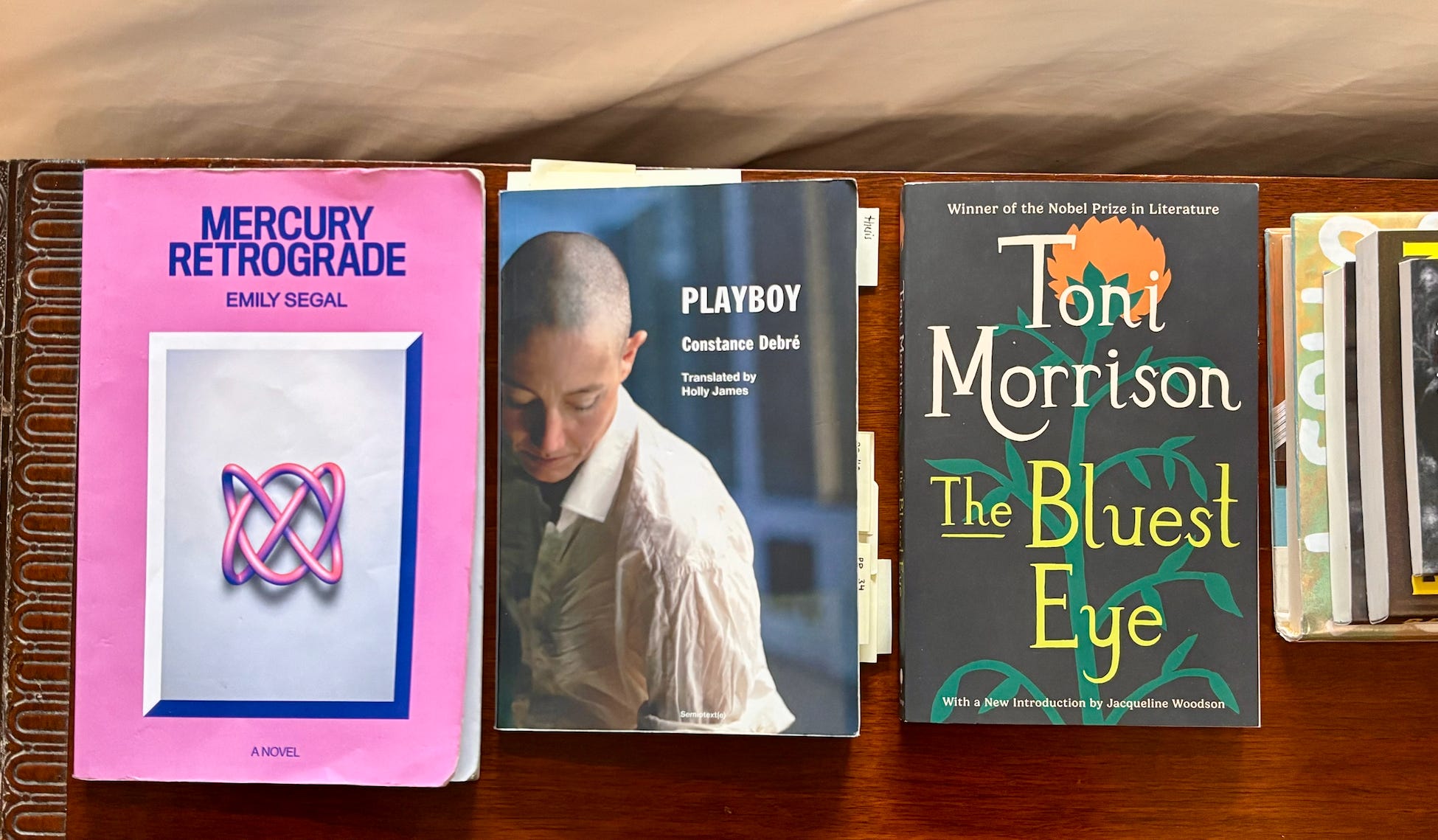
March: 🔗 Mercury Retrograde by Emily Segal
April: 🔗 Playboy by Constance Debré
I was going to start in January but things got busier with work. I’ve reread both of these texts already, but need time to work out the commentary/structure here.
(P.S. I’ll love you forever if you skip Amazon and support Bookshop.org or your local indie or Libby or your library. I personally think the BK public library app is the hottest new social media on the market. Use CODE JKTHERESNOCODE I’m just messing.)
February is for Mercury Retrograde.
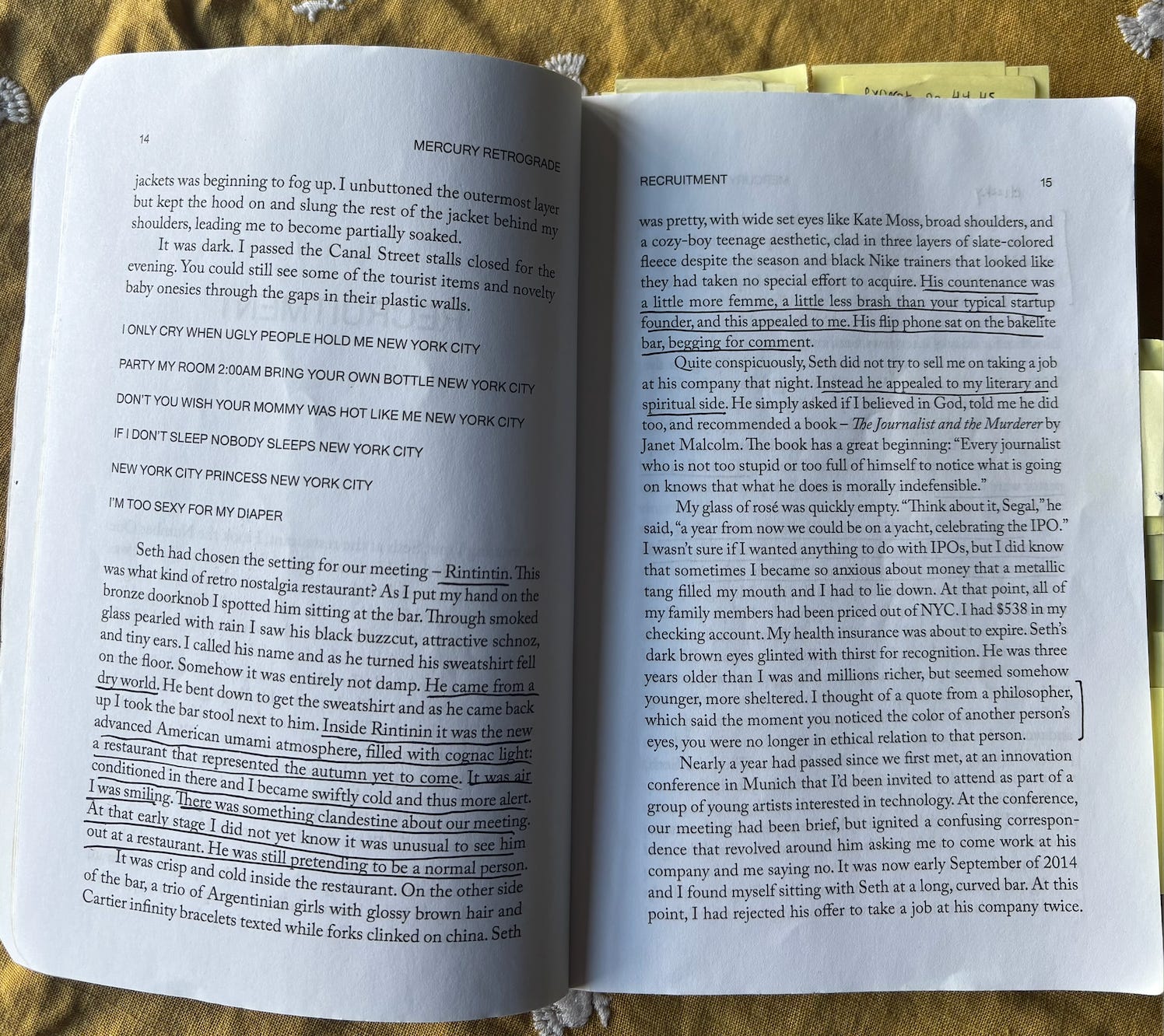
Kicking off the year with Mercury Retrograde (Deluge Books, 2020) by Emily Segal, a trend forecaster and founding member of the art collective K-HOLE, where she famously coined the term “normcore.” Emily is also a founder of nemesis global, a creative strategy consulting firm.
Rather than hem and haw my way around the plot (which intellectually simmers and boils over like a rich broth), I think Eileen Myle’s’ blurb does most of the heavy lifting here. Fact: when in doubt, defer to Eileen Myles.
“I really liked reading this book. It’s the longest reply to ‘where have you been?’ you’ll ever get from someone you first met in a skype chat which Emily Segal is to me. It’s a brilliantly written novel of a moment in search of a shimmer, half ‘here’, half digital, an everywhere post branding workplace place where few have dared to live and this writer, explorer, critic, philosopher of nonbusiness has done it deep. Segal’s style is widely smart, different than deep (always). I mean her Mercury Retrograde is, it truly is.”
Mercury Retrograde both blithely observes and exactingly critiques 2010s New York and tech startup culture in a way that still feels fresh, even as those very “disruptors” now try to limply impress shareholders with an AI Hail Mary in 2026.
In short, this is one of the smartest books I’ve read. It’s cerebral and not afraid to be perceived as pretentious. As a debut, it’s unconcerned with being for everyone, and if you don’t get it, that’s fine. It made me excited about novels again.
I’ll save the rest for later.
March is for Playboy.
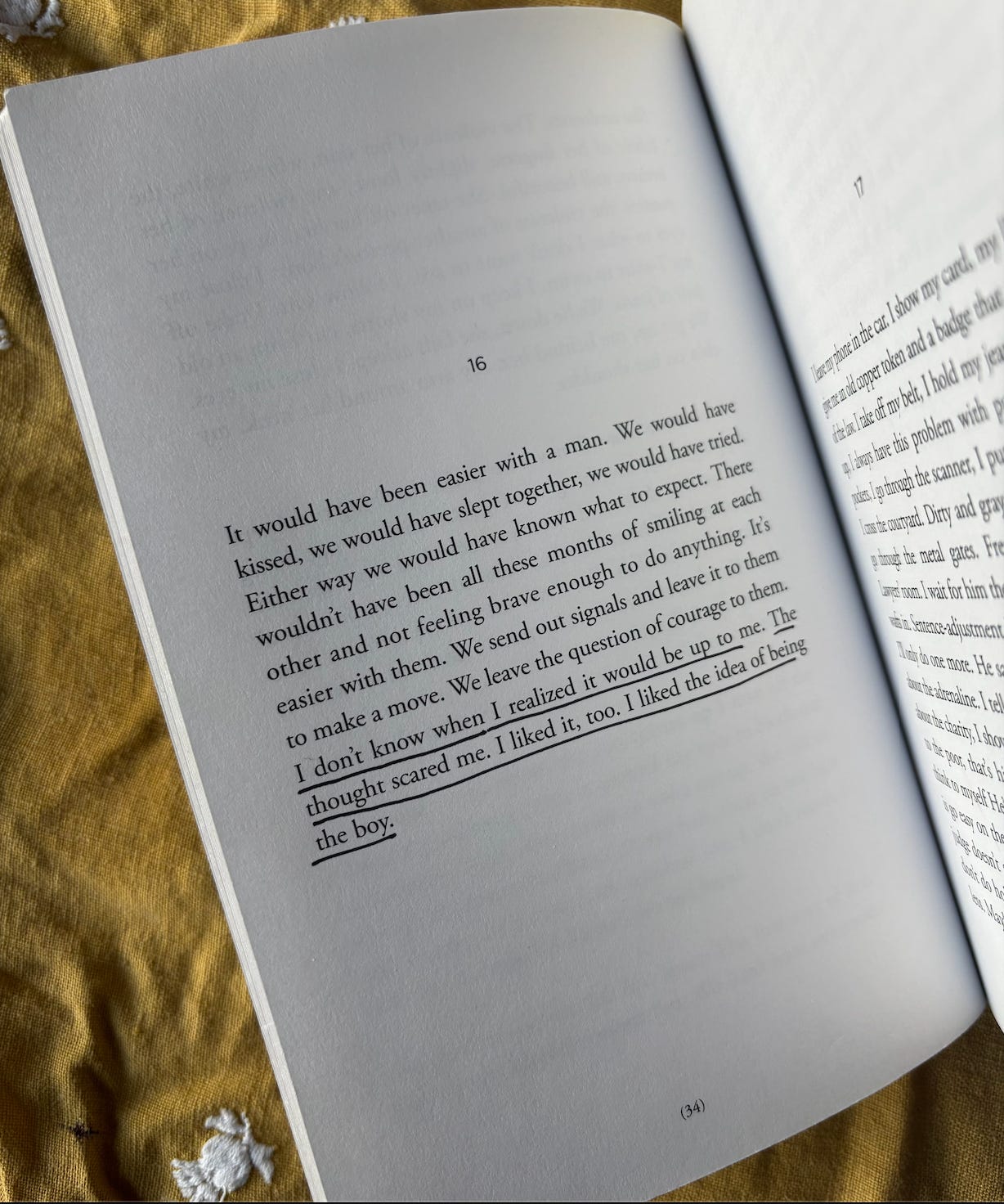
Playboy is the first novel in an autofictional triptych by writer Constance Debré, published by Semiotext(e) and translated from French by Holly James in 2018.
This novel is gay as hell, described as “detached” and “Laconian,” and the prose is sparse. For that and much more, I love it and return to it often.
The protagonist, once a respected criminal defense lawyer and mother to young son Paul, leaves her husband, comes out as a lesbian, and finds herself in a series of love affairs ranging from tepid to torrid. She assumes somewhat the position of ascetic in reverse, allowing herself two primary pleasures: swimming and women.
“If Debré's novels were monotonously cynical or grim they would be far less pleasurable to read. They are brutal, but they are also something more—and that is very, very funny.”
— Anahid Nersessian, The New York Review of Books
More seriously, Playboy mines what happens when, periodically, we experience a total dissolution of the self. The destruction and rebuilding we’re capable of. The dynamite now, the mortar later. And isn’t that what every winter is? A dissolution of the former self and then you have to figure out how—and why—to live again.
Exhausting, exacting, horny, messy. Perfect for the liminal space between winter and Spring.
rough draft syllabi
My thought is I’m going to take May off for “Spring Break” and come back in June with another cohort of debuts. I’ll be figuring out this format in real time, so thoughts/ideas welcome!
For example, in the fall we might return to some classics to really tap into the college literature seminar nostalgia. Imagine we’re in the park reading Lahiri or Lispector, a slight chill in the air!! Delicious.
Still working through the details, but a few ideas here:
Luster, Raven Leilani
The Coin, Yasmin Zaher
Pond, Claire-Louise Bennett
Ponyboy, Duncan Eliot
The Bluest Eye, Toni Morrison
The Namesake, Jhumpa Lahiri
Books that excite me tend to:
experiment with form and structure, often vignette-based
generally classified as literary fiction
written predominantly by women and queer authors
modern (i.e. published in the last 10 years) but I’m planning out the back half of my list and will be adding in some classics to stretch those particular writing and reading muscles
not purple prose-y — there tends to be a similar restraint or tightness in the prose of projects in my personal canon. it’s hard to describe this quality at the moment, something I’m working towards assigning a vocabulary to
So come one, come all for novel gazing!!
for your next personal day
Bringing this back!
ML Buch, Suntub
I saw ML Buch play at Pioneer Works in December 2024, and the show left an imprint on me that lasted the whole year. Buch came onstage in a fabulous coat, guitar-wielding, blonde hair catching the stage lights. After a few moments of sound check and equipment fiddling, she removed the coat to reveal she was several months pregnant.
Near the end of the set, she played the song “Working it out” from her 2023 album Suntub, which goes:
“your body can care / body can care / your body can care for another”
Buch, visibly pregnant, living out her song’s lyrics in real time. It stirred up my emotions. How we might live our art eventually. I walked the entire way home from Red Hook in drizzling rain thinking about that.
Your body can care for another. In case you needed the reminder, too.
Witnessing Humanity: The Art of John Wilson
If you have time to visit The Met this winter, I was deeply moved by the John Wilson exhibit on view until February 8, 2026. Witnessing Humanity: The Art of John Wilson tracks decades of the artists’ political life and family life.
Wilson’s works feel wholly modern, even his self-portraits from the 1940s, partly because of the direct address of his gaze. I love an exhibit that spans the life of an artist. We get to witness the direct impact of time he spent in Mexico City and Paris on his artistic life.
“Working in a figurative style, Wilson sought to portray what he called “a universal humanity.” While still a teenager, he was struck by the absence of positive representations of Black Americans and their experiences in both museums and popular culture. To counter such prejudices and omissions, Wilson put the experiences of Black Americans at the center and created images that portrayed dignity and strength.”
He draws salient parallels with his work, including how Nazi ideologies regularly studied and borrowed from the mechanics of American slavery and Jim Crow Era sanctions. This intersectionality serves as a prescient reminder of all the places in the world today where these same patterns repeat hundreds of years later, and that collective liberation and Wilson’s concept of “universal humanity” is never truly done.


Cate Le Bon, Michelangelo Dying
Finally, Cate Le Bon’s newest album Michelangelo Dying was on repeat in my house and headphones most of the last three months of the year.
Loosely, it’s about the collapse of a long-term relationship, and the songs land more like abstract poems. Buzzy guitars. Obfuscated, at times sparse lyrics. The album is felt without its precise context being expressly understood.
In our waning cultural obsession with manufactured authenticity, I find it refreshing when art rejects the vulnerability trap. So much art is too on the nose lately, too diaristic. I miss subtext.
Le Bon’s album feels singular in its hurting, but on “Heaven Is No Feeling,” she sings matter-of-factly:
“Don’t you want more love than you’ve ever dreamed of?”
The answer is a universal, resounding yes.
I’m having fun writing it, I promise. it’s just taking a long time.
oo thanks for sharing all these book recs <3 adding to my list!! Mercury retrograde seems up my alley